
Categories
Tags
algorithms APIT Arc arm assembly asynchronous base64 BitHacks Blogging box c clang-format client cmake compiler concat concurrency const_fn contravariant cos covariant cpp Customization cybersecurity DataStructure db debugging Demo deserialization discrete doc DP dtruss Dynamic Example FFI flat_map format FP fsanitize Functional functions futures Fuwari GATs gccrs generics gitignore glibc GUI hacking hashmap haskell heap interop invariant iterator join justfile kernel LaTeX leak LFU linux lto MachineLearning macOS Markdown math ML mmap nc OnceLock optimization OS panic parallels perf physics pin postgresql radare2 release reverse RPIT rust sanitizer science Science serialization server shift sin SmallProjects socket std strace String StringView strip strlen surrealdb SWAR swisstable synchronous tan toml traits triangulation UnsafeRust utf16 utf8 Video wsl x86_64 xilem zig
7238 words
36 minutes
250601_List_of_logic_symbols_unicode_val_logic_name_001
List of logic symbols
- https://en.wikipedia.org/wiki/List_of_logic_symbols
- 한글 https://ko.wikipedia.org/wiki/%EC%88%98%ED%95%99_%EA%B8%B0%ED%98%B8
- In logic, a set of symbols is commonly used to express logical representation. The following table lists many common symbols, together with their name, how they should be read out loud, and the related field of mathematics. Additionally, the subsequent columns contains an informal explanation, a short example, the Unicode location, the name for use in HTML documents,[1] and the LaTeX symbol.
| Symbol | Unicode value (hexadecimal) | HTML codes | LaTeX symbol | Logic Name | Read as | Category | Explanation | Examples |
|---|---|---|---|---|---|---|---|---|
⇒ → ⊃ | U+21D2 U+2192 U+2283 | ⇒ → ⊃ ⇒ | \Rightarrow \implies \to or \rightarrow \supset | material conditional (material implication) | implies, if P then Q, it is not the case that P and not Q | propositional logic, Boolean algebra, Heyting algebra | is false when A is true and B is false but true otherwise. In other mathematical contexts, see glossary of mathematical symbols, may indicate the domain and codomain of a function and may mean superset. | is true, but is in general false (since x could be −2). |
⇔ ↔ ≡ | U+21D4 U+2194 U+2261 | ⇔ ↔ ≡ ⇔ | \Leftrightarrow \iff \leftrightarrow \equiv | material biconditional (material equivalence) | if and only if, iff, xnor | propositional logic, Boolean algebra | is true only if both A and B are false, or both A and B are true. Whether a symbol means a material biconditional or a logical equivalence, depends on the author’s style. | |
¬ ~ ! ′ | U+00AC U+007E U+0021 U+2032 | ¬ ˜ ! ′ ¬ | \lnot or \neg \sim ' | negation | not | propositional logic, Boolean algebra | The statement is true if and only if A is false. A slash placed through another operator is the same as placed in front. The prime symbol is placed after the negated thing, e.g. [2] | |
∧ · & | U+2227 U+00B7 U+0026 | ∧ · & ∧ | logical conjunction | and | propositional logic, Boolean algebra | The statement A ∧ B is true if A and B are both true; otherwise, it is false. | ||
∨ + ∥ | U+2228 U+002B U+2225 | ∨ + ∥ ∨ | \lor or \vee \parallel | logical (inclusive) disjunction | or | propositional logic, Boolean algebra | The statement A ∨ B is true if A or B (or both) are true; if both are false, the statement is false. | n ≥ 4 ∨ n ≤ 2 ⇔ n ≠ 3 when n is a natural number. |
⊕ ⊻ ↮ ≢ | U+2295 U+22BB U+21AE U+2262 | ⊕ ⊻ ↮ ≢ ⊕ | \oplus \veebar \not\equiv | exclusive disjunction | xor, either ... or ... (but not both) | propositional logic, Boolean algebra | The statement is true when either A or B, but not both, are true. This is equivalent to ¬(A ↔ B), hence the symbols and . | |
⊤ T 1 | U+22A4 | ⊤
| \top | true (tautology) | top, truth, tautology, verum, full clause | propositional logic, Boolean algebra, first-order logic | denotes a proposition that is always true. | The proposition is always true since at least one of the two is unconditionally true. |
⊥ F 0 | U+22A5 | ⊥ ⊥ | \bot | false (contradiction) | bottom, falsity, contradiction, falsum, empty clause | propositional logic, Boolean algebra, first-order logic | denotes a proposition that is always false. The symbol ⊥ may also refer to perpendicular lines. | The proposition is always false since at least one of the two is unconditionally false. |
∀ () | U+2200 | ∀ ∀ | \forall | universal quantification | given any, for all, for every, for each, for any | first-order logic | or says “given any , has property .” | |
∃ | U+2203 | ∃ ∃ | \exists | existential quantification | there exists, for some | first-order logic | says “there exists an (at least one) such that has property .” | n is even. |
∃! | U+2203 U+0021 | ∃ ! ∃! | \exists ! | uniqueness quantification | there exists exactly one | first-order logic (abbreviation) | says “there exists exactly one such that has property .” Only and are part of formal logic. is an abbreviation for | |
( ) | U+0028 U+0029 | ( ) ( | ( ) | precedence grouping | parentheses; brackets | almost all logic syntaxes, as well as metalanguage | Perform the operations inside the parentheses first. | (8 ÷ 4) ÷ 2 = 2 ÷ 2 = 1, but 8 ÷ (4 ÷ 2) = 8 ÷ 2 = 4. |
| U+1D53B | 𝔻 𝔻 | \mathbb{D} | domain of discourse | domain of discourse | metalanguage (first-order logic semantics) | |||
⊢ | U+22A2 | ⊢ ⊢ | \vdash | syntactic consequence | proves, syntactically entails | metalanguage (metalogic) | says “is a theorem of ”. In other words, proves via a deductive system. | |
⊨ | U+22A8 | ⊨ ⊨ | \vDash, \models | semantic consequence or satisfaction | (semantically) entails or satisfies, models double turnstile | metalanguage (metalogic) | says “in every model, it is not the case that is true and is false”. says is true in a model with variable assignment . | |
≡ ⟚ ⇔ | U+2261 U+27DA U+21D4 | ≡ — | \equiv \Leftrightarrow | logical equivalence | is logically equivalent to | metalanguage (metalogic) | It’s when and . Whether a symbol means a material biconditional or a logical equivalence, depends on the author’s style. | |
⊬ | U+22AC | ⊬\nvdash | does not syntactically entail (does not prove) | metalanguage (metalogic) | says “is not a theorem of ”. In other words, is not derivable from via a deductive system. | |||
⊭ | U+22AD | ⊭\nvDash | does not semantically entail | metalanguage (metalogic) | says “does not guarantee the truth of ”. In other words, does not make true. | |||
□ | U+25A1 | \Box | necessity (in a model) | box; it is necessary that | modal logic | modal operator for “it is necessary that” in alethic logic, “it is provable that” in provability logic, “it is obligatory that” in deontic logic, “it is believed that” in doxastic logic. | says “it is necessary that everything has property ” | |
◇ | U+25C7 | \Diamond | possibility (in a model) | diamond; it is possible that | modal logic | modal operator for “it is possible that”, (in most modal logics it is defined as “¬□¬”, “it is not necessarily not”). | says “it is possible that something has property ” | |
∴ | U+2234 | ∴\therefore | therefore | therefore | metalanguage | abbreviation for “therefore”. | ||
∵ | U+2235 | ∵\because | because | because | metalanguage | abbreviation for “because”. | ||
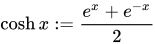
≔ ≜ ≝ | U+2254 U+225C U+225D | ≔ ≔ | ≔ \coloneqq := \triangleq
\scriptscriptstyle \mathrm{def}}{=} | definition | is defined as | metalanguage | means "from now on, is defined to be another name for ." This is a statement in the metalanguage, not the object language. The notation may occasionally be seen in physics, meaning the same as . | |
↑ | ⊼ | U+2191 U+007C U+22BC | \uparrow | Sheffer stroke, NAND | NAND, not both up arrow | Propositional logic | NAND is the negation of conjunction so is true if and only if it's not the case that both A and B are true. See also NAND gate | ||
↓ ⊽ | U+2193 U+22BD | \downarrow | Peirce Arrow, NOR | nor down arrow | Propositional logic | NOR is the negation of disjunction so is true if and only if both A and B are false. See also NOR gate |






























250601_List_of_logic_symbols_unicode_val_logic_name_001
https://younghakim7.github.io/blog/posts/250601_list_of_logic_symbols_unicode_val_logic_name_001/